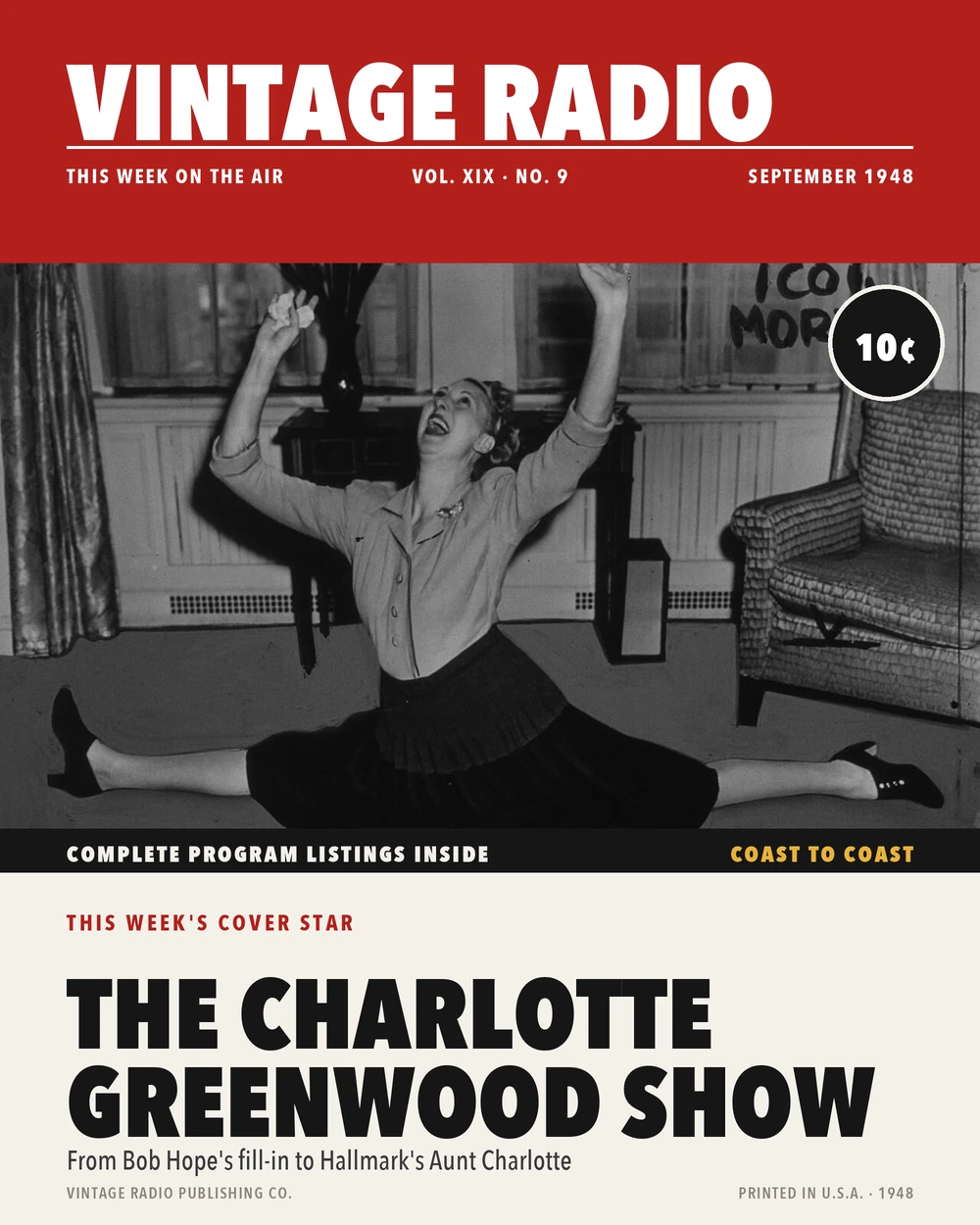
The Charlotte Greenwood Show
From Vaudeville to a Prime Tuesday Slot
Charlotte Greenwood came to radio in the summer of 1944 through a gap left by Bob Hope. Hope's wartime USO commitments kept him from honoring his NBC Pepsodent contract, and Greenwood stepped into his Tuesday 10 p.m. slot for thirteen weeks. Hope's Pepsodent program was one of radio's top-rated shows, and Greenwood walked into a built-in listenership on a network that valued the hour.
Greenwood, born Frances Charlotte Greenwood in Philadelphia on June 25, 1890, had spent decades on the stage before she got there. She was a vaudeville fixture billed as "Lady Longlegs," a nickname earned by her nearly six-foot frame and the sideways high kicks that became her signature. By 1944 she was a familiar Hollywood face as well, which made her a credible stand-in for one of the medium's biggest stars.
The NBC run lasted from June 13 to September 5, 1944 — half-hour episodes, Tuesdays at 10. Shirley Mitchell and Arthur Q. Bryan joined her in the cast; Matty Malneck led the orchestra; the Three Hits and a Miss vocal group filled out the musical spots. John Guedel produced, and Ray Singer and Phil Leslie wrote the scripts. According to columnist Hedda Hopper, Greenwood had landed the program partly because her husband, composer Martin Broones, had written a couple of scripts for it — his first work in radio.
What the Character Was
During the NBC run, Greenwood played a neophyte reporter on a small-town newspaper who aspired to Hollywood stardom — a setup that let the writers put her in comic situations without asking the audience to accept too much. New York Times critic John K. Hutchens reviewed the show after its early episodes and offered what can fairly be called backhanded praise, describing the comedy as "gentle" and "pretty tame" compared to Hope's style. He called the plots "little," "mild," and "ingratiating," noting that the show leaned on Greenwood's long-established arsenal of comic tricks and quips.
The character shifted considerably when the show moved to ABC. From October 15, 1944, through January 6, 1946, Greenwood played "Aunt Charlotte," a woman living in the fictional small town of Lakeview who had taken over raising three Barton children — young Robert and teenagers Jack and Barbara — while also trying to keep the Barton estate solvent. The estate didn't offer much to work with: a heavily mortgaged house, a lunchroom near the high school that barely paid for itself, and an unproductive farm.
The ABC run aired on Sundays — at 3 p.m. until April 1945, then at 5:30 — with Hallmark Cards as sponsor. Edward Arnold occasionally co-starred as Mr. Reynolds, a lawyer, though he was known to laugh louder than the studio audience. Wendell Niles announced. The regular cast included John Brown, Harry Bartell, Eddie Ryan, Will Wright, Ed MacDonald, and Veola Vonn.
Aunt Charlotte was kind, good, and quick with a homily: "a man who seeks gold for its own sake may succeed in making a lot of money, but he fails to make anything out of himself." One contemporary listener characterized her as a character who "managed to be single, moral, and peppy" — a combination that fit the Hallmark sponsorship neatly and gave the ABC run a noticeably different texture from the summer NBC version.
The Aunt Eller Connection
The Aunt Charlotte character anticipates something larger in Greenwood's career. She had originally been the intended choice to play Aunt Eller in the 1943 Broadway premiere of Rodgers and Hammerstein's Oklahoma!, but film commitments prevented her from taking it, and the role went to Betty Garde. Greenwood eventually did play Aunt Eller in the 1955 film adaptation — the role her biographer Grant Hayter-Menzies regards as her masterpiece. The warm, wise, surrogate-maternal quality that defined Aunt Charlotte on radio ran through both characters, suggesting the radio work was part of how Greenwood developed that persona.
What Survives and What It Left Behind
Producer John Guedel went on to create You Bet Your Life for Groucho Marx in 1947, co-create People Are Funny and House Party with Art Linkletter, help launch The Adventures of Ozzie and Harriet on CBS radio, and produce Earn Your Vacation — the 1954 game show that gave Johnny Carson his first starring role on network television. The Greenwood show sat near the start of that run.
Greenwood retired from performing in 1956 after finishing The Opposite Sex, came briefly out of retirement in 1961 for two television appearances, and died in Los Angeles on December 28, 1977. She left her personal papers to playwright William Luce, who later contributed an afterword to Hayter-Menzies's Charlotte Greenwood: The Life and Career of the Comic Star of Vaudeville, Radio and Film (McFarland, 2007).
One unusual honor belongs specifically to this radio series. Greenwood's star on the Hollywood Walk of Fame — placed February 8, 1960, at 1601 Vine Street — is in the Radio category, recognizing her radio work rather than her film career. That's a rare designation, and the Hayter-Menzies biography explicitly cites The Charlotte Greenwood Show as the basis for it. For a program the Times once called mild and ingratiating, that's a durable legacy.